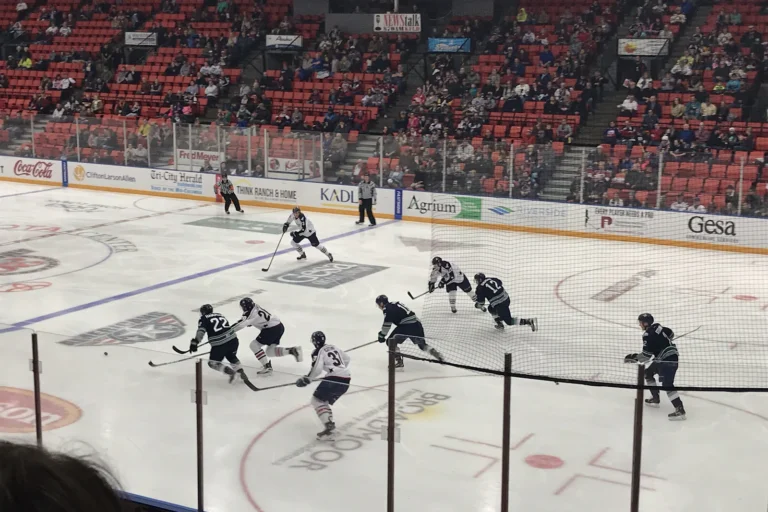
If you have been to a Tulsa Oilers game, you have seen the ECHL logo on the ice and on the jerseys. But what exactly is the ECHL, how does it relate to the NHL, and where do the Oilers fit in? Here is a clear, fan-friendly explanation.
The ECHL in 2026-27
- Teams: 30, in 24 U.S. states and one Canadian province
- Season: opened October 16, 2026; regular season ends April 11, 2027
- Games: 72 per team in the regular season
- Trophies: Kelly Cup (playoff champion) and Brabham Cup (best regular-season record)
- Newest team: the New Mexico Goatheads, an expansion club in Rio Rancho
Where the ECHL sits in pro hockey
North American professional hockey works like a ladder. At the top is the National Hockey League. Directly below it is the American Hockey League (AHL), where most NHL teams keep their top prospects. One step below the AHL is the ECHL, often described as “AA” hockey in baseball terms. Below that are other minor pro leagues, such as the SPHL.
The ECHL was founded in 1988 as the East Coast Hockey League. As it expanded across the country, it shortened its name to simply “ECHL” in 2003, and the letters no longer stand for anything.
What “affiliation” means
Most ECHL teams have a working agreement with an NHL club and its AHL farm team. The Tulsa Oilers are affiliated with the Anaheim Ducks of the NHL and the San Diego Gulls of the AHL, a partnership that began in 2020.
In practice, affiliation means:
- The Ducks and Gulls can assign players under contract to Tulsa so they get regular playing time.
- Oilers players can be called up to San Diego when the Gulls need help because of injuries or call-ups of their own.
- Goaltenders, in particular, move between levels often, since teams need a reliable backup at every step.
That movement is why ECHL rosters change so frequently during a season. A player you cheer for in October might be playing in the AHL by December — which is a success story for him and for Tulsa.
Who plays in the ECHL?
ECHL rosters mix several kinds of players:
- Prospects assigned by NHL or AHL clubs to develop with more ice time.
- Recent college and junior graduates starting their pro careers.
- Veterans who have built long careers at this level and provide leadership — Tulsa’s Tyler Poulsen is a good example.
Hundreds of players have used the ECHL as a stepping stone to the NHL, and many NHL coaches and executives spent time in the league as well.
How the league is organized
The 30 teams are split into two conferences with two divisions each:
| Conference | Division | Teams |
|---|---|---|
| Eastern | North | Adirondack, Greensboro, Maine, Norfolk, Reading, Trenton, Trois-Rivières, Worcester |
| Eastern | South | Atlanta, Florida, Greenville, Jacksonville, Orlando, Savannah, South Carolina |
| Western | Central | Bloomington, Cincinnati, Fort Wayne, Indy, Kalamazoo, Toledo, Wheeling |
| Western | Mountain | Allen, Idaho, Kansas City, New Mexico, Rapid City, Tahoe, Tulsa, Wichita |
Because of travel costs, teams play most of their games within their own division. That is why Tulsa sees Wichita 14 times this season but plays only a handful of games against Eastern Conference teams.
Kelly Cup and Brabham Cup
The ECHL awards two major team trophies. The Brabham Cup goes to the team with the best regular-season record. The Kelly Cup is the league championship, won in the spring playoffs, where the top teams from each division advance through several best-of-seven rounds.
Tulsa has not yet won a Kelly Cup. Its deepest ECHL run came in 2018-19, when the Oilers reached Game 7 of the Western Conference Final. The defending Brabham Cup champion, the Kansas City Mavericks, plays in Tulsa’s own division — so the road to a title runs straight through a familiar rival.
Why the ECHL is great for fans
- Affordable tickets compared with NHL games.
- Close access to players, especially at autograph sessions and postgame skates.
- Fast, physical hockey played by athletes fighting for their next opportunity.
- Community connection — teams like the Oilers are woven into their cities in a way big-league franchises rarely are.
For the official standings, statistics and transactions, the best source is the league itself at official league website. To see how Tulsa has fared since joining the league in 2014, read our season-by-season history of the Oilers since 2014, and if you want to follow games from home, here is how to watch Tulsa Oilers games.
Ready to see it in person? Our 2026-27 season preview lists the dates worth circling.