Few moments confuse new fans more than a referee’s raised arm. Play keeps going, the goalie skates to the bench, and suddenly someone is sitting in a box beside the ice. This guide explains hockey penalties in plain English: the main types, the most common calls, what the referee’s signals mean and how penalties change the game. It is written for fans at the BOK Center, but the basics apply at any level.
Quick answer: Most hockey penalties are minor penalties, which send a player to the penalty box for two minutes while his team plays shorthanded. More serious fouls draw a five-minute major, a 10-minute misconduct or an ejection. When a team is penalized, the other team gets a power play. Professional leagues, including the ECHL, use rules closely based on the NHL rulebook, while amateur play follows the USA Hockey rulebook.
The Main Types of Hockey Penalties
| Penalty type | Length | What it usually means |
|---|---|---|
| Minor | 2 minutes | The most common call; ends early if the other team scores |
| Double minor | 4 minutes | Often for high-sticking that causes an injury |
| Major | 5 minutes | Fighting or a dangerous foul; does not end if a goal is scored |
| Misconduct | 10 minutes | A player sits out, but his team is not shorthanded |
| Game misconduct or match penalty | Rest of the game | The most serious fouls, often reviewed by the league afterward |
| Penalty shot | One attempt | Awarded when a clear scoring chance is illegally stopped |
Why minor penalties can end early
If a team scores on a power play during a minor penalty, the penalized player returns to the ice right away. In contrast, a major penalty must be served in full, no matter how many goals are scored. That is why a five-minute major can change the outcome of a game.
The Most Common Hockey Penalties
You will hear these calls almost every night:
- Tripping: Using a stick, knee or foot to make an opponent fall.
- Hooking: Using the blade of the stick to pull or slow down an opponent.
- Holding: Grabbing an opponent’s body, jersey or stick with the hands.
- Slashing: Swinging the stick at an opponent’s body or stick.
- Interference: Blocking or hitting a player who does not have the puck.
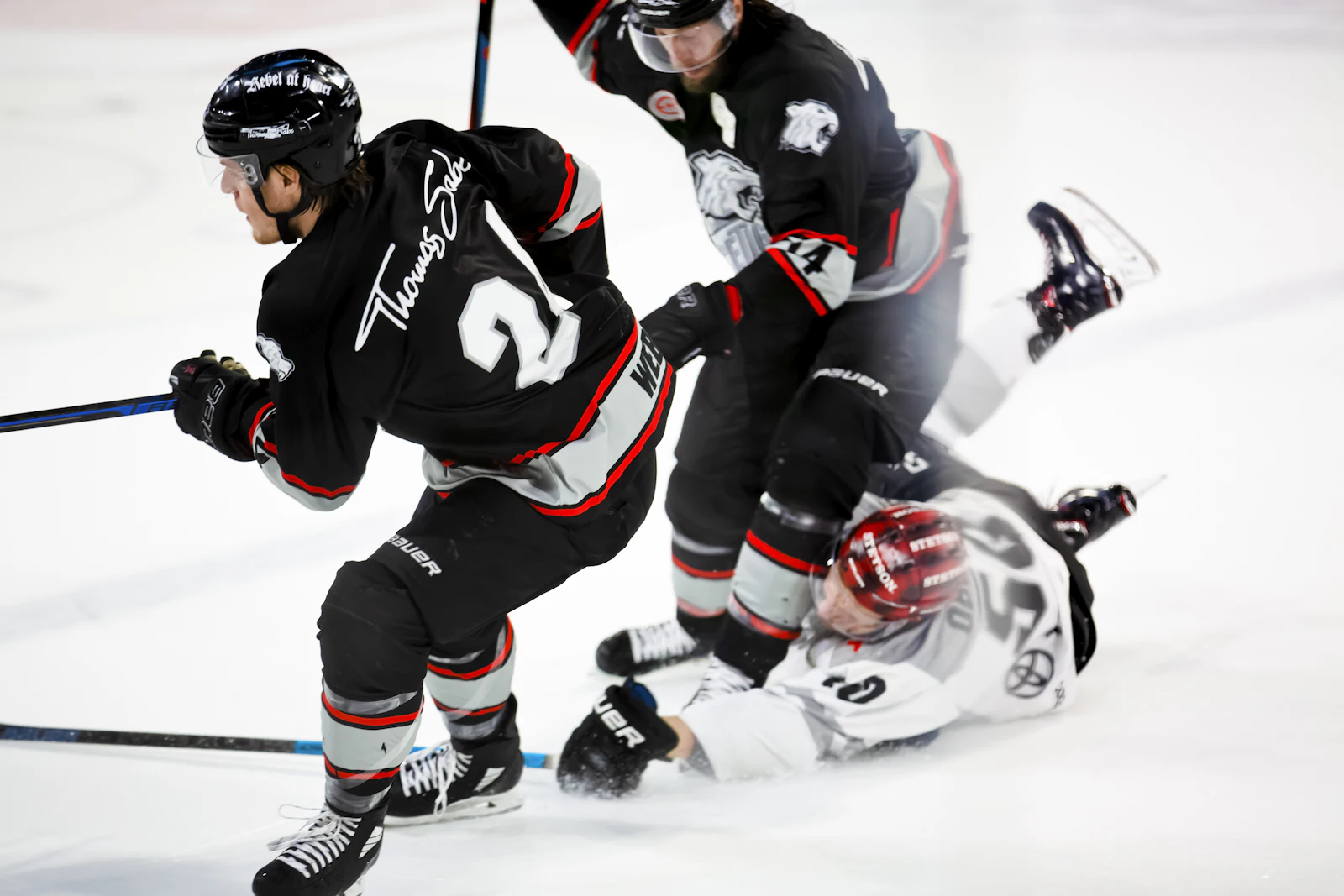
- High-sticking: Hitting an opponent with a stick above the shoulders.
- Cross-checking: Hitting an opponent with the shaft of the stick held in both hands.
- Roughing: Excessive pushing or punching, often after the whistle.
- Too many men on the ice: A bench penalty for a sloppy line change.
- Delay of game: For example, shooting the puck over the glass from your own defensive zone.
Reading the Referee’s Signals
Referees use a hand signal for each penalty, so you can often tell the call before the announcer says it. A few are easy to learn:
- Tripping: The referee strikes the side of his leg below the knee.
- Hooking: A tugging motion with both arms, as if pulling something toward the body.
- Holding: One hand grabs the opposite wrist in front of the chest.
- Slashing: A chopping motion with one hand across the other forearm.
- High-sticking: Both fists held one above the other at the side of the head.
The delayed penalty
When a referee raises an arm but does not blow the whistle, a delayed penalty is coming. Play continues until the penalized team touches the puck. Meanwhile, the other team usually pulls its goalie for an extra attacker, since it cannot be scored on in that situation except by its own mistake. As a result, the final seconds before the whistle are often a burst of pressure.
How Hockey Penalties Change the Game
A penalty creates special teams. The team with the extra skater is on the power play, and the shorthanded team is on the penalty kill. Good teams score on the power play and limit chances on the kill, and that difference often decides close games.
Sometimes the shorthanded team scores anyway. That is a short-handed goal, and it can swing momentum quickly. For a recent example, Kyle Kukkonen scored short-handed for Tulsa on opening night, as explained in our opening night recap.
Coincidental penalties and four-on-four
If players from both teams are penalized at the same time, the penalties may cancel out on the ice, or the teams may play four-on-four, depending on the type of penalty. Four-on-four hockey opens up the ice and often produces scoring chances.
What About Fighting?
Fighting still happens in minor-league hockey, although far less often than it once did. Players who fight usually receive five-minute majors. In addition, leagues can add misconducts, ejections or suspensions for instigating a fight or for fights late in games. If you would rather your children did not watch, it is easy to redirect their attention, and officials usually step in quickly.
Where to Learn More
Hockey penalties make more sense once you know the basics of the game. Start with our hockey rules guide for new fans, then use our hockey terms glossary to decode words like “shorty” and “five-on-three.” For the full professional rules, the official NHL rulebook (PDF) is the main reference that minor-league rules are built on.
Published Oct. 25, 2026. This is a simplified guide for fans. Specific penalty lengths, signals and supplementary discipline vary by league and season, so consult the official rulebook for exact wording.